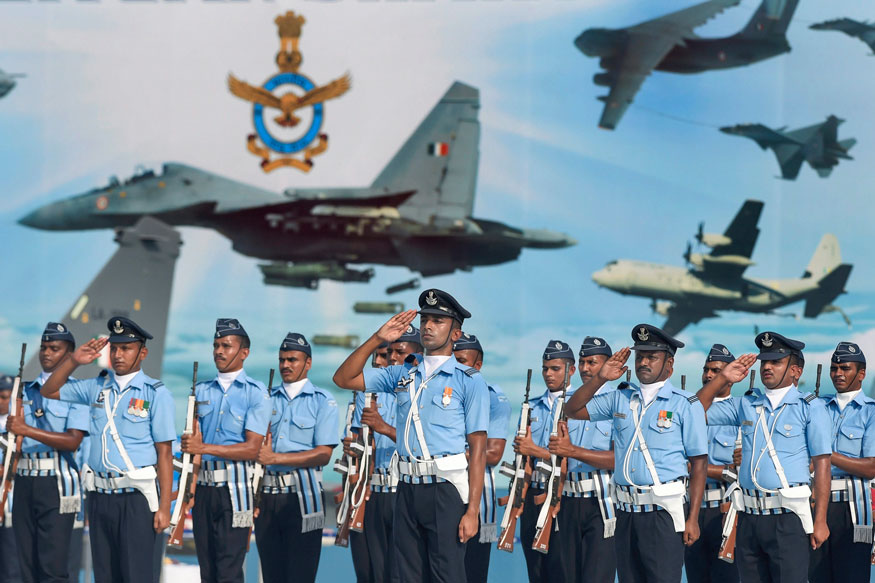
The Indian Air Force (IAF) is the air arm of the Indian Armed Forces. Its complement of personnel and aircraft assets ranks fourth amongst the air forces of the world.[7] Its primary mission is to secure Indian airspace and to conduct aerial warfare during armed conflict. It was officially established on 8 October 1932 as an auxiliary air force of the British Empire which honoured India's aviation service during World War II with the prefix Royal.[8] After India gained independence from the United Kingdom in 1947, the name Royal Indian Air Force was kept and served in the name of Dominion of India. With the government's transition to a Republic in 1950, the prefix Royal was removed after only three years.
Since 1950 the IAF has been involved in four wars with neighboring Pakistan and one with the People's Republic of China. Other major operations undertaken by the IAF include Operation Vijay, Operation Meghdoot, Operation Cactus and Operation Poomalai. The IAF's mission expands beyond engagement with hostile forces, with the IAF participating in United Nations peacekeeping missions.
The President of India holds the rank of Supreme Commander of the IAF.[9] As of 1 July 2017, 139, 576 personnel are in service with the Indian Air Force.[10][11] The Chief of Air Staff, an air chief marshal, is a four-star officer and is responsible for the bulk of operational command of the Air Force. There is never more than one serving ACM at any given time in the IAF. The rank of Marshal of the Air Force has been conferred by the President of India on one occasion in history, to Arjan Singh. On 26 January 2002 Singh became the first and so far, only five-star rank officer of the IAF.
The Indian Air Force was established on 8 October 1932 in British India as an auxiliary air force[18] of the Royal Air Force. The enactment of the Indian Air Force Act 1932[19][20] stipulated out their auxiliary status and enforced the adoption of the Royal Air Force uniforms, badges, brevets and insignia.[21] On 1 April 1933, the IAF commissioned its first squadron, No.1 Squadron, with four Westland Wapiti biplanes and five Indian pilots. The Indian pilots were led by British RAF Commanding officer Flight Lieutenant (later Air Vice Marshal) Cecil Bouchier
The Indian Air Force is divided into five operational and two functional commands. Each Command is headed by an Air Officer Commanding-in-Chief with the rank of Air Marshal. The purpose of an operational command is to conduct military operations using aircraft within its area of responsibility, whereas the responsibility of functional commands is to maintain combat readiness. Aside from the Training Command at Bangalore, the primary flight training is done at the Air Force Academy, Dundigul (located in Hyderabad), followed by operational training at various other schools. Advanced officer training for command positions is also conducted at the Defence Services Staff College; specialised advanced flight training schools are located at Bidar, Karnataka and Hakimpet, Telangana (also the location for helicopter training). Technical schools are found at a number of other locations.
Rank structure
Main article: Air Force ranks and insignia of India
The rank structure of the Indian Air Force is based on that of the Royal Air Force. The highest rank attainable in the IAF is Marshal of the Indian Air Force, conferred by the President of India after exceptional service during wartime. MIAF Arjan Singh is the only officer to have achieved this rank. The head of the Indian Air Force is the Chief of the Air Staff, who holds the rank of Air Chief Marshal.
Best NDA Class In Pune (Dignitary)